This Harry Potter transfiguration activity is a fun way to help your child develop and explore a growth mindset, creativity, and the skill of flexible thinking.
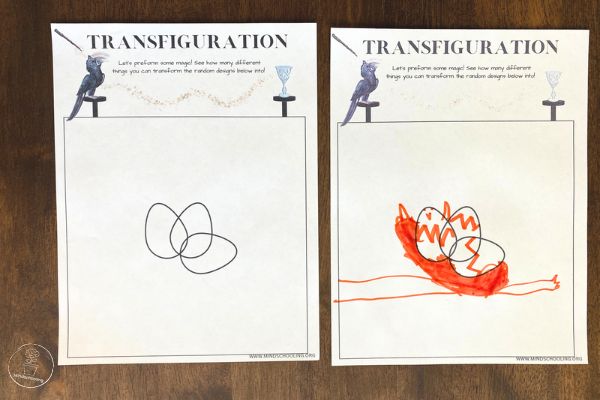
In the story of Harry Potter, transfiguration is a family of magic spells that are used to turn one thing or person into something or someone completely different. A metamorphosis so to speak.
If you have read the books or seen the movies, you know Professor McGonagall’s trick. If not, no worries, I will not spoil it here. But I will say that it takes a very talented, dedicated, and skilled witch to be able to do that!
It’s no different for muggles. Trying to see something from seemingly nothing is not always easy. Or, looking at one thing and being able to turn it into another. Now that takes some practice and skill. This means it takes working at; we aren’t all born with this skill.
This activity builds that muscle and sharpens that skill. So grab a pen, a piece of paper, and any extra patience and creativity you may have, and see what you can create using your flexible thinking!
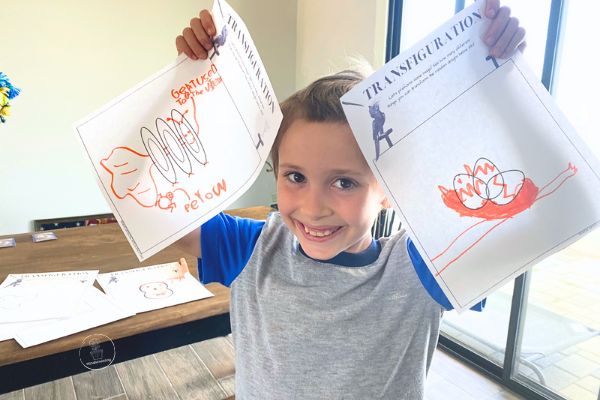
How to set up the Harry Potter Transfiguration activity
This activity is super easy and low maintenance! All you need are the supplies below and your beautiful brain! Let’s get started!
Supplies:
- Transfiguration Printables (get them below!)
- Pens, pencils, or markers of different colors
Instructions:
1. Present the printables to your child. And point out the markings on the paper without direction or even suggestions at this point. It can sound something like this: “Oh I am noticing this squiggle over here” or “Wow, look at these wavy type circles! I wonder what they could turn into?”
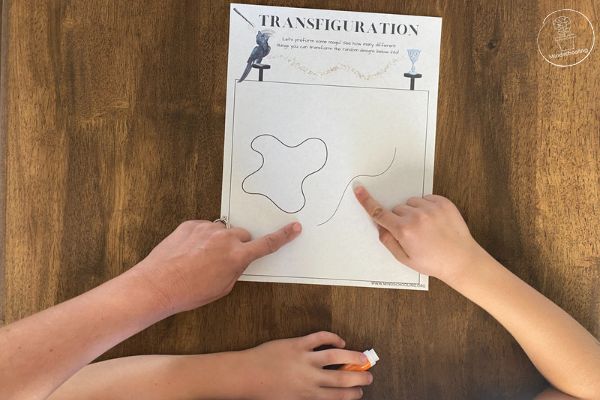
2. Let your child choose how many of the designs they would like to do. There will be some easier designs and some that are more difficult for each child. Flexible thinking doesn’t always come easy.
Every child, just like every human, is different and sees things differently so be sure to offer all the designs to the child and let them pick which ones are inspiring to them at first; even if it’s just one.
Then, once they get into the groove and feel more confident with their ability, you can offer some of the more challenging ones for them that they refused at first. Even doing some of the same ones over and over can be helpful.

3. Invite them to turn the shapes into a picture. If they struggle at first, you can ask them what they think the shape could be. Make sure to give the child plenty of time to ruminate and think about what they can turn the design into.
They could need to walk away and come back to the activity later on after their brain has had time to digest it. Try not to give any ideas or suggestions at first, unless the child asks. Let them try to work that muscle.
If the child asks for help, definitely give support. Withholding that guidance, even with the best of intentions can backfire and the child can resist it because it may feel too hard for them. Building a growth mindset can be challenging and they may need some support.
It is important to also make sure the child can have their ideas and not be fed yours. Offering support without having your ideas become theirs, can be tricky. A helpful way can sound something like this “It sounds like this is a challenge for you. Let’s take this one step at a time. Have you ever seen anything with this shape before?”
Or if the design is a bit overwhelming, you can cover part of the design and ask “Hmm, what does this remind us of?” You can also turn the page to get a different perspective. Sometimes looking at it from another angle can be all the child needs to be successful.
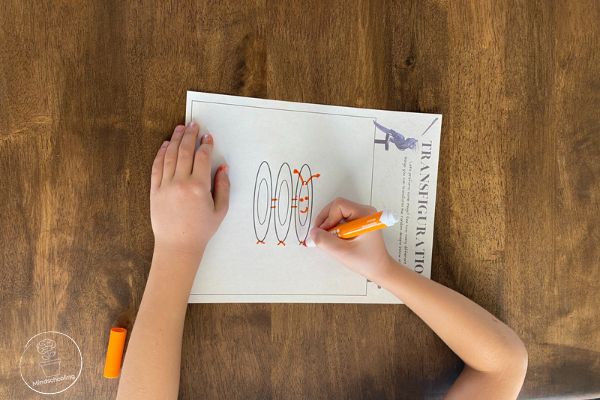
Another way to offer support without it being your idea is to offer several outcomes. It can sound like this “This wavy line here, it reminds me of the vine on a bush, or a fish fin, or even the way a dog’s ear lies at the side of its head, or maybe even the brim of a birthday hat! What have you seen that has that same shape?”
With that many options, it allows them the chance to see the possibilities and invites their brain to start exploring options. In the end, if they end up choosing one of your examples, that is fine. It is the first step for them and that is a big deal for those who struggle with this skill. This exercise, even if it is from your idea, allows them to start to work that muscle, and maybe the next time they will have the confidence to come up with their own.
Creativity doesn’t come naturally to all of us. Sometimes it helps to give them quiet or even a little space if they are struggling. It’s all about meeting the child where they are and building from there. So whether they need to step away for a time or blast through them all right away,

4. Admire the growth and work that went into this masterpiece. You can offer the child to color in the picture if they want or even write or tell a story about the picture they came up with. Offer some verbal praise like “I can tell you worked hard at changing what was there before”.
Then hang it up somewhere the child can see it and be inspired every day by their growth, their work, and their flexibility. If the child does not want to hang it up, obviously that is perfectly fine too!
Extensions:
You can expand this activity by using the blank printable and then drawing a random squiggle or line on it. Make several if you want! Then invite the child to use the lines you made to make a picture or story. Have the child use a different color drawing utensil than you did so it is easy to see what was added. This comes in handy when more than one person adds to the picture or story. This would make a great group activity!
Another way to expand this activity is by taking some small geometric shapes or a blank piece of paper cut up into different shapes and arranging them into a certain picture. Take a circle and some triangles and make a fish shape for example. Then invite the child to use the same circle and triangles to make something completely different! A kitty cat head perhaps. Now that is a true transfiguration!
You can use this activity with younger kiddos too! Simply draw a shape they might be familiar with, like a heart, a circle, or a diamond. Then they can turn it into something by using it in the drawing they create. For example, a heart can turn into a butterfly wing. Or a diamond can be the toenail of a crocodile. You can keep repeating the shapes so that it invites them to keep thinking and to maybe dig deeper on how to change the shape into something.
Another way to expand this activity, once the child is feeling more confident in this skill, is to theme them. So you can say “Let’s turn these shapes into something new! Let’s make them all be something you would find in a house” or “Let’s try to make these all end up being things found in the ocean”, for example.
You can also do another set of the same designs as the last time, only this time, they have to end up being something completely different than the first drawing!
If your kiddos are enjoying learning about themselves while exploring the magical world of witchcraft & wizardry, and they want more, you can grab all 8 of our Harry Potter mindfulness printables for just $1.29!

(If you just want the free file, feel free to go to the individual posts to grab to grab them. It will ask you to enter in your information for each activity printable, but don’t worry, I won’t send you duplicate emails.)
Social Emotional Learning Behind the Harry Potter Transfiguration Activity
Being able to develop and grow a growth mindset is a very important part of mental health and navigating hardship. If one doesn’t have tools showing them how to stay afloat during difficult times, it can be easy to feel or stay stuck in hardship for even longer.
Having a growth mindset is being able to know and believe that things can improve. Whether that is learning a new skill, striving for academic achievement or even knowing that sadness doesn’t last and a new feeling will come.
It is also about the willingness to try new things. As we all know, trying new things can be difficult because we don’t always succeed at first. There can be mistakes, setbacks, and delays. Being able to observe this and use creativity and flexible thinking to find a solution is where success starts.
Many studies and papers, like this one, or research like this, show the benefits of flexible thinking and developing a growth mindset, and why it is so very important for our health and happiness.
Flexible thinking is also a large part of one having the ability to self-regulate through strong emotions as well. So it’s pretty easy to see how important it is to learn how to develop a growth mindset and flexible thinking.
That’s exactly why I created this activity. To give children a fun, engaging, and lasting way to use a tool for a growth mindset and flexible thinking so they can grow into all they want to be!
Empowering your kids to get creative in problem-solving and finding the light in the world can change the world for them. As the wise Professor Dumbledor said, “It matters not what someone is born, but what they grow to be.”
Check out these other Harry Potter Social Emotional Learning Activities:
- Harry Potter Remembrall Activity – Positive Mindset
- Harry Potter Sorting Hat Activity – Character Building / Self Acceptance
- Harry Potter House Crest Activity – Self Affirmation
- Harry Potter Boggart Activity – Facing Fear & Defeating Worry
- Harry Potter Mirror of Erised Activity – Achieving Goals / Tenacity
- Harry Potter Marauder’s Map Activity – Self Care / Authenticity / Safety
- Harry Potter Defeat Voldemort Activity – Confidence / Defeating Fear
Hello,
Could you send me the transfiguration activity sheet pack via email? I am planning on using them for Harry Potter-themed-Halloween this year.
Thank you! It will help a lot!